


An overview of the decay channels of pions, muons and p 0's is given in tables 3.1 and 3.2.

|
Process
|
R
=
 /[Gamma] /[Gamma]
|

|
p +->µ+ n µ
|
(99.98770±0.00004)%
|

|
p +->µ+ n µ g
|
(1.24±0.25)·10-4
|

|
p +->e+ n e
|
(1.230±0.004)·10-4
|

|
p +->e+ n e g
|
(1.61±0.23)·10-7
|

|
p +-> p 0e+ n e
|
(1.025±0.034)·10-8
|

|
Process
|
R
=
 /[Gamma] /[Gamma]
|

|
Process
|
R
=
 /[Gamma] /[Gamma]
|

|
µ+->e+ n e µ µ
|
(98.6±0.4)%
|

|
p 0-> g g
|
(98.798±0.032)%
|

|
µ+->e+ n e µ g µ g
|
(1.4±0.4)%
|

|
p 0->e+e- g
|
(1.198±0.032)%
|

|
µ+->e+ n e µ
e+e- µ
e+e-
|
(3.4±0.4)·10-5
|
 Figure
3.1:
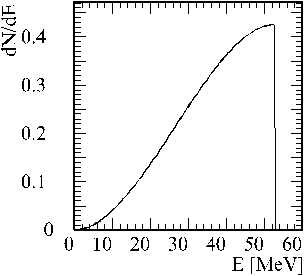
Michel spectrum of positrons from muon decays at rest.
The main decay of the pion
( p +->µ+ n µ) produces
a monoenergetic µ+ which decays with a lifetime of
[tau]µ [congruent] 2.2µs mainly into
µ+->e+ n e
Figure
3.1:
Michel spectrum of positrons from muon decays at rest.
The main decay of the pion
( p +->µ+ n µ) produces
a monoenergetic µ+ which decays with a lifetime of
[tau]µ [congruent] 2.2µs mainly into
µ+->e+ n e
 µ
( p µe chain). For stopped pion decay experiments where the pion
is assumed to be at rest before decaying, the muon has a kinetic energy of
Tµ [congruent] 4.12 MeV. Since the range of
the µ+ is very small ( about 1mm in scintillator
material) the µ+ is also stopped in the target and the
muon decay occurs at rest too. The energy spectrum of the e+
from the decay
µ
( p µe chain). For stopped pion decay experiments where the pion
is assumed to be at rest before decaying, the muon has a kinetic energy of
Tµ [congruent] 4.12 MeV. Since the range of
the µ+ is very small ( about 1mm in scintillator
material) the µ+ is also stopped in the target and the
muon decay occurs at rest too. The energy spectrum of the e+
from the decay
 is the Michel spectrum, shown in Fig. 3.1, with a maximum energy of
52.83 MeV. Positrons from the p µe chain are the main
background for all stopped pion decay experiments.
is the Michel spectrum, shown in Fig. 3.1, with a maximum energy of
52.83 MeV. Positrons from the p µe chain are the main
background for all stopped pion decay experiments.